
Hamstring Workout
A dedicated hamstring session built around the hip hinge and knee flexion, run twice a week for six weeks to build the back of your legs properly.
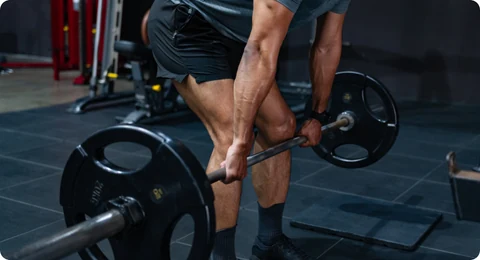
Program Overview
Hamstrings do two separate jobs: they extend the hip and they bend the knee. Most lower body training only covers the first, which is why so many lifters have strong squats and underdeveloped hamstrings. This session trains both functions in every workout, pairing hinge movements like the Romanian deadlift with direct knee flexion work. It is deliberately short, around ten hard sets, because it is built to sit on top of your existing leg training rather than replace it. Well developed hamstrings also protect the knee and improve how much you can load a squat, so this pays off well beyond appearance. Every exercise includes a form video where one is available.
This is a specialization block, not a full program. Slot it into a week alongside our leg day workout, or run our 4-day lower body focus program if you want a complete lower body plan.
Who Is This For?
This workout suits you if:
- Your hamstrings lag behind your quads and glutes
- You want a stronger deadlift and a more stable knee
- You have access to a barbell and a leg curl machine
- You already train legs and want to add focused volume
This works best inside a complete week. Browse our muscle building programs to build it into your split.
Weekly Schedule
Phase 1: Build the Stretch (Weeks 1-3)
The first three weeks emphasize the lengthened position, which is where hamstrings grow fastest. Take four full seconds to lower on every hinge movement. You will need far less weight than you expect, and you will be sore in the first week regardless.
Four seconds down on every hinge. If you cannot control the lowering, the weight is too heavy.
Hold the barbell at hip height, push your hips back and lower until you feel a hamstring stretch.
Seated in the machine with the pad on your lower calves, curl your heels underneath you.
Stagger the feet with most weight on the front leg and hinge at the hip.
Rise onto the balls of your feet and lower for a full stretch.
A relaxed walk on your off days. It adds up more than people expect over eight weeks.
A short mobility circuit for the hips and thoracic spine.
Phase 2: Add Load (Weeks 4-6)
Now that the tissue tolerates the range, the loads climb. The deficit deadlift adds range at the bottom of the hinge and the lying leg curl brings the hip into a different position from the seated version, which changes where the work lands along the muscle.
Keep three seconds on the lowering even as the weight climbs. The moment it becomes a drop, you have lost the reason this works.
Stand on a low platform and deadlift from the increased range of motion.
Face down in the machine, curl your heels toward your glutes and lower slowly.
With your ankles anchored, lower your torso forward under control and pull back up.
Rise onto the balls of your feet and lower for a full stretch.
A relaxed walk on your off days. It adds up more than people expect over eight weeks.
A short mobility circuit for the hips and thoracic spine.
Nutrition Guidance
This is extra volume on top of your existing leg training, so your nutrition does not need to change. It just needs to already be covering the basics. Our macro calculator sets your calorie and protein targets, and our recipes make hitting them easier. For more depth, read why your tracking might be off and timing cardio with lifting.
What Actually Matters Here
- Protein: 1.6 to 2.2g per kg of bodyweight daily. Hamstrings take a beating from loaded stretching, and protein is what turns that damage into growth.
- Calories: Stay wherever your main program has you. Adding a specialization block is not a reason to eat more. Use our macro calculator if you have not set that yet.
Extra hard sets need extra recovery. Protein and total calories are what pay for them.


