
Cable Workout Plan
An upper body focused program built entirely on the cable stack, using constant tension and adjustable angles across three sessions a week, with posterior chain and core work on the third day.
Program Overview
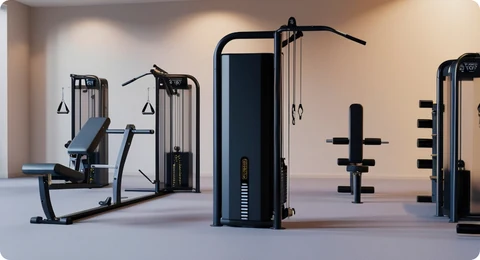
Cables do something free weights cannot: they keep tension on the muscle through the entire range of motion. A dumbbell fly is nearly weightless at the top, a cable fly is not. You can also change the angle of resistance in a way that gravity simply does not allow. This eight-week program uses the cable stack for everything across three sessions, which makes it a genuinely good option in a busy gym where the squat racks are always taken. Be clear on what it is, though: two upper body days plus a third covering the posterior chain and core. A cable stack cannot load a squat pattern properly, so if you want quad development, keep a squat or leg press elsewhere in your week. Every exercise includes a form video.
For a heavier free weight version of the same upper body work, see our upper body workout plan for mass. Our push day workout covers the same pressing patterns with barbells and dumbbells.
Who Is This For?
This program suits you if:
- You want constant tension and a strong mind muscle connection
- Your gym has a well equipped cable area and busy free weight racks
- You have a few months of training experience
- You have squat or leg press work covered elsewhere, or are happy to add it
Browse everything built for size on our muscle building programs page.
Weekly Schedule
Phase 1: Find the Tension (Weeks 1-4)
Cables reward control, not momentum. Set up far enough from the stack that the weight never rests on the pin at the start of a rep. Keep the tempo deliberate, roughly two seconds down and one second up, and hold the fully contracted position for a beat on every rep.
Position yourself so the stack never touches down mid set. Constant tension is the entire reason to use cables.
Press the handles forward from chest height until the arms are extended.
From low pulleys, sweep the handles up and together in front of your chest.
With a soft elbow bend, bring the handles together in front of your chest.
Push a rope attachment down and split the ends apart at the bottom.
Facing away from the pulley, extend the arms overhead against the cable.
Pull the bar down to your upper chest by driving the elbows down and back.
Pull the handle to your midsection, keeping the torso upright.
Hinged forward with cables crossed, open the arms wide against the resistance.
Curl a low pulley handle up with elbows pinned to your sides.
Curl a rope attachment with a neutral grip, pulling the ends apart at the top.
Facing away from a low pulley, hinge back and drive your hips forward against the cable.
With a cuff on your ankle, drive the leg back against the cable.
Drive the leg out to the side against the cable, standing tall.
Kneeling at a high pulley, crunch down by flexing the spine, not the hips.
Rotate and pull the cable diagonally across your body from high to low.
An easy walk to move blood through the muscles you trained without adding fatigue.
Gentle mobility for whichever joints felt stiff getting into position last session.
Phase 2: Add Angles and Intensity (Weeks 5-8)
Single arm variations come in, which expose side to side differences and let you rotate through a longer range than a two handed version allows. On the last set of each exercise, once you cannot complete another clean rep, drop the pin two plates and keep going to failure again.
One drop set on the final exercise of each session is plenty. Cables make drop sets easy, which makes it tempting to overdo them.
Press the handles forward from chest height until the arms are extended.
With a soft elbow bend, bring the handles together in front of your chest.
From low pulleys, sweep the handles up and together in front of your chest.
With cables crossed from opposite pulleys, push down and extend both elbows.
Extend one arm overhead against a low cable, keeping the elbow high.
Pull the bar down to your upper chest by driving the elbows down and back.
Row a single handle to your side, allowing a longer range through the torso.
Pull the handle to your midsection, keeping the torso upright.
Hinged forward with cables crossed, open the arms wide against the resistance.
Curl a low pulley handle up with elbows pinned to your sides.
Facing away from a low pulley, hinge back and drive your hips forward against the cable.
On all fours or standing, drive the working leg back and up against the cable.
With a cuff on your ankle, drive the leg back against the cable.
Kneeling at a high pulley, crunch down by flexing the spine, not the hips.
Rotate and pull the cable diagonally across your body from high to low.
An easy walk to move blood through the muscles you trained without adding fatigue.
Gentle mobility for whichever joints felt stiff getting into position last session.
Nutrition Guidance
Constant-tension work generates a lot of fatigue for the numbers on the stack, so recovery matters more here than the loads suggest. Our macro calculator sets your calorie and protein targets, and our recipes make hitting them easier. For more depth, read why you are always hungry on a diet and how to tell if your training is working.
The Basics
- Calories: A surplus of roughly 250 a day is enough. Bigger surpluses add fat faster than they add muscle. Our macro calculator sets your starting point.
- Protein: Aim for 1.6 to 2.2g per kg of bodyweight a day. Constant-tension work produces a lot of muscle damage, and protein is what repairs it. Browse our recipes for ideas.
- Meal timing: Get a meal with protein and carbs in within a few hours either side of training. The exact window matters far less than most people think.
- Sleep: Short sleep blunts recovery and appetite regulation at the same time, which makes everything else harder.
Weigh yourself weekly and average it. Gaining roughly 0.25 to 0.5 percent of bodyweight a month is about right.